

Manish Kumar
Climatic impacts of aerosols are the centre of concern for a long period. Ranging from human health, climate dynamics, visibility etc, it has many widespread effects. Out of its various impacts on visibility, climate change and human health, the latter comes as one of the most crucial issues which pose a threat to sustainability in terms of economic and social crisis.
A number of epidemiological studies revealed a link between fine particles with a diameter lower than 2.5μm (PM2.5 ) and a variety of adverse effects on human health, including both respiratory and cardiac diseases. However, recent epidemiological studies indicated that the relationship between inhalation of PM and adverse health effects cannot be solely explained by the PM10 and PM2.5 mass concentration levels. Other physical, chemical or biological properties also play an important role in the effects of particulate matter on human health. Several chemical components, including specific elements found in particulate matter, have been implicated in a variety of cardio-respiratory illnesses associated with exposure to urban air pollution.
The projections of future trends of aerosols made from various observed and modelled studies indicate many challenges to sustainability in one or another way, misbalancing the link between ecological, economical and social aspects. Human-induced aerosols scatter and absorb solar radiation and they are responsible for producing brighter and less efficient clouds which mainly result in reductions in solar irradiance and alterations in rainfall leading to a weaker hydrological cycle affecting the availability of freshwater which is one of the key challenges for sustainability in 21st century. The idea about sustainability issues posed by atmospheric aerosols can be understood in Figure 1 which relates various anthropogenic aerosols with socio-economic issues of life.
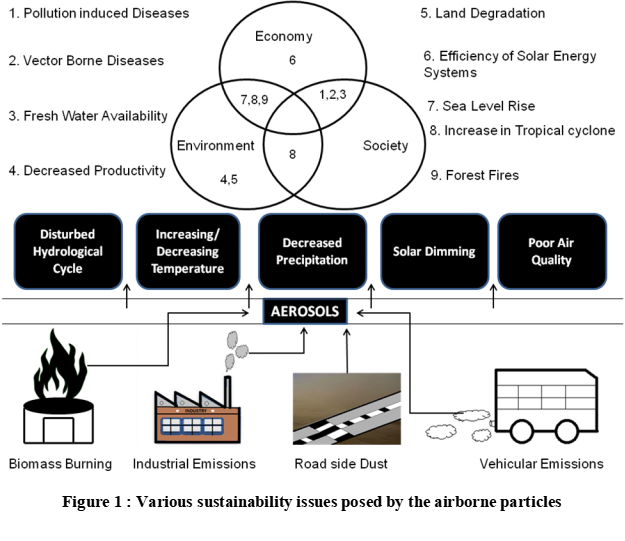
Projected changes in the climatic patterns in terms of temperature, humidity and change in precipitation attributed either to pollutant gases or aerosols are expected to have a deteriorating effect on various local, regional and global levels. Regional vulnerabilities due to the changing climate pose varying effects on ecological, social and economic aspects of life. Natural ecosystems, regional hydrology, production of food and fibres, damage to coastal zones as well as human health are the main areas of regional vulnerabilities that should be taken as the highest concerns for future sustainability challenges.
The improvements to air quality can bring significant improvements to human health in a very short time frame. From 1980 to 2000, reductions in fine particulate matter accounted for 15% of the overall increase in life expectancy in the U.S. Because of the serious health impacts of local air pollution and the impacts of climate change on air quality, adapting improved air quality management techniques in light of changing climate is especially required. This is one of the reasons why improved policies regarding air quality and human health consider meteorological variables in determining when, where, and how to control pollution emissions, usually assuming that weather observed in the past is a good proxy for weather that will occur in the future when control policies are fully implemented. There is a growing recognition that the development of optimal control strategies to control future levels of key health-relevant pollutants like ozone and fine particles (PM2.5 ) should incorporate an assessment of potential future climate conditions and their possible influence on the attainment of air quality objectives.
Ecosystem services, one of the important pillars of the GDP and economic assets of any country, can be highly affected by the direct and indirect effects of aerosols. The tolerable windows for climate change have included limits not only to global mean temperature increase but also to rates of increase, e.g., 0.2°C per decade. One reason, for instance, is the difficulty of natural ecosystems to adapt to rapid climate change. Some studies have predicted that 70% of all ecosystems and 83% of all forest ecosystems would be unable to adapt to a local temperature rise of 0.3°C per decade. In this context, global and local rates of temperature change of 0.4 and 0.8°C/ decade, as mentioned above, loom large. Climate change and impacts, like air quality, are regionally variable and have to be dealt with on a regional basis.
123 Fifth Avenue, NY 10160, New York, USA | Phone: 800-123-456 | Email: Unitysupportus@info.com
© 2022 Created with Royal Elementor Addons